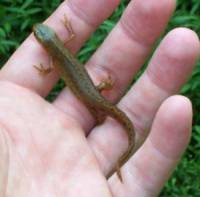
.. MY NEWT�S BIGGER THAN YOUR NEWT ! ..
.. Contributed by Lawrence Skuse ..
How times change. Back in the balmy (barmy?) days of the 1950s and 1960s we children did all sorts of things that are frowned upon now, or are downright illegal. I have to add, that in some cases the more modern approach is correct, as will be seen.
Take �newting� for example; these days you have to be someone like Ken Livingstone in order to handle a newt, let alone snatch it from its natural habitat and imprison it in a sweet jar bought from �Deakie�s� shop on Five Locks Road (or �Heol Pum Loc� today?!). Back in those far off days, come spring, a shilling (or thereabouts, 5 pence in today�s money) bought you a bamboo cane with a nylon fishing net on the end. Armed with this and a jam jar (what else?), we would head for the canal, by what is now the Five Locks Marina, and hunt the three spined stickleback Gasterosteus aculateus. However, newts were the star catch � the common or smooth newt Triturus vulgaris, and the palmated newt Triturus helveticus; although there was a third, the great crested or warty newt Triturus cristatus, more of which later.
Lying on your stomach you could get a good view of the bottom of the �nal and acquire targets amongst the weed. Early in the season, in March, if a newt was within net reach of the bank he was easy prey since, having just returned to the water after hibernation, he needed frequent trips to the surface for gulps of air. Having broken the surface, he would jacknife and dive as straight as an arrow to the bottom - or a well placed net. Attempts to catch them �fairly� by chasing them with the net often ended in failure due to their agility.
As was stated above, smooth and palmated newts were the most common, but there was also the very rare (and still is today) great crested newt. In my childhood there was only ever one recorded catch of this monster, by Ian Powell from �The Prefabs� (Pen y Parc). This is a bit of a mystery as they are said to prefer running water to stagnant. This was an awesome creature, dwarfing its more common relatives, and we would often call in to the Powells� garden to admire the beast. Sadly, it escaped from the sweet jar, and was trodden on by Ian�s mother as she put out washing on the line (well, I did say they are rare today).
Later my interest turned to smaller prey after a birthday present of a Britax zoom microscope. I would then trawl the canal with a home made net constructed from a coat hanger, the leg of one of my mother�s old tights and a small glass jar secured at the end; microscopic organisms would gather in the jar, to be taken home and examined at leisure as specimens. For reference, I had the �Observer�s Book of Pond Life�. Creatures such as daphnia, amoeba, hydra, paramecium and the like would be placed on a slide and put under the microscope, but one year I found, and mounted in a slide, the much rarer and more exciting Volvox aureus (yeah, I know, anorak).
As I hinted at the beginning, such activities are now very �non-eco friendly�, not to say illegal, and rightly so, but I do consider myself lucky for all manner of reasons to have been a child at that time. Perhaps the less said about my childhood egg collection the better!